 Shruti Kaushik
Write about the problem you are solving, the choices behind the product and what a potential customer should understand. A SaaS founder does not need to invent customer stories to publish useful content. Be clear about what is built, what is being tested and what remains a hypothesis.
Credible founder content built from product decisions and real problems before customer proof exists.
- One problem you can describe honestly
- One product decision with a trade-off
- A working example or focused question
Why this gets difficult
Early-stage founders often borrow the language of a mature company before they have the evidence behind it. The result sounds confident but gives a reader little to inspect. You do not need a large case study library to be useful; you need to be clear about what you observed, what you built and what remains unproven.
A decision is a good unit of founder content. Explain the problem, the alternatives you considered and why you chose one. Include the downside. A reader can evaluate that reasoning even when you cannot yet demonstrate an improvement in conversion, retention or revenue.
Explain a product choice without inventing traction
Our revolutionary platform transforms team productivity and drives unprecedented growth.
We chose to show one starting task instead of every feature after sign-up. The aim is to make the first step clearer. The trade-off is that experienced users may want faster access to the full workspace. We still need to measure whether the change helps new users finish the task.
This illustrative passage separates a design intention from a measured result. It makes the product decision open to discussion and gives a prospective user something specific to assess. It is not a claim that this change has improved Klype’s activation rate.
Follow the workflow, screen by screen
Use these screens as a map, then apply the example to your own workspace. Each step explains what to look for, not just which page to open.
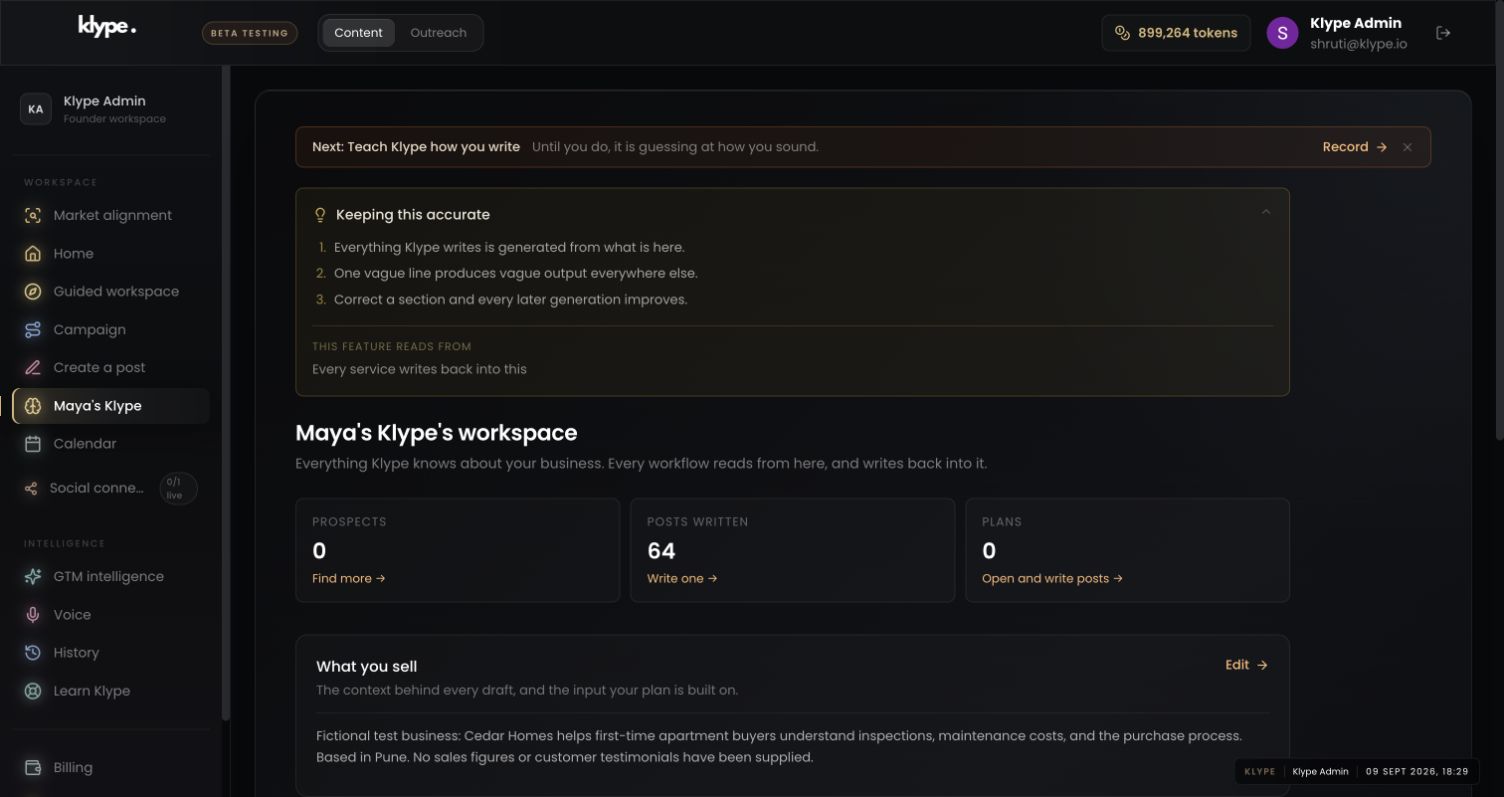
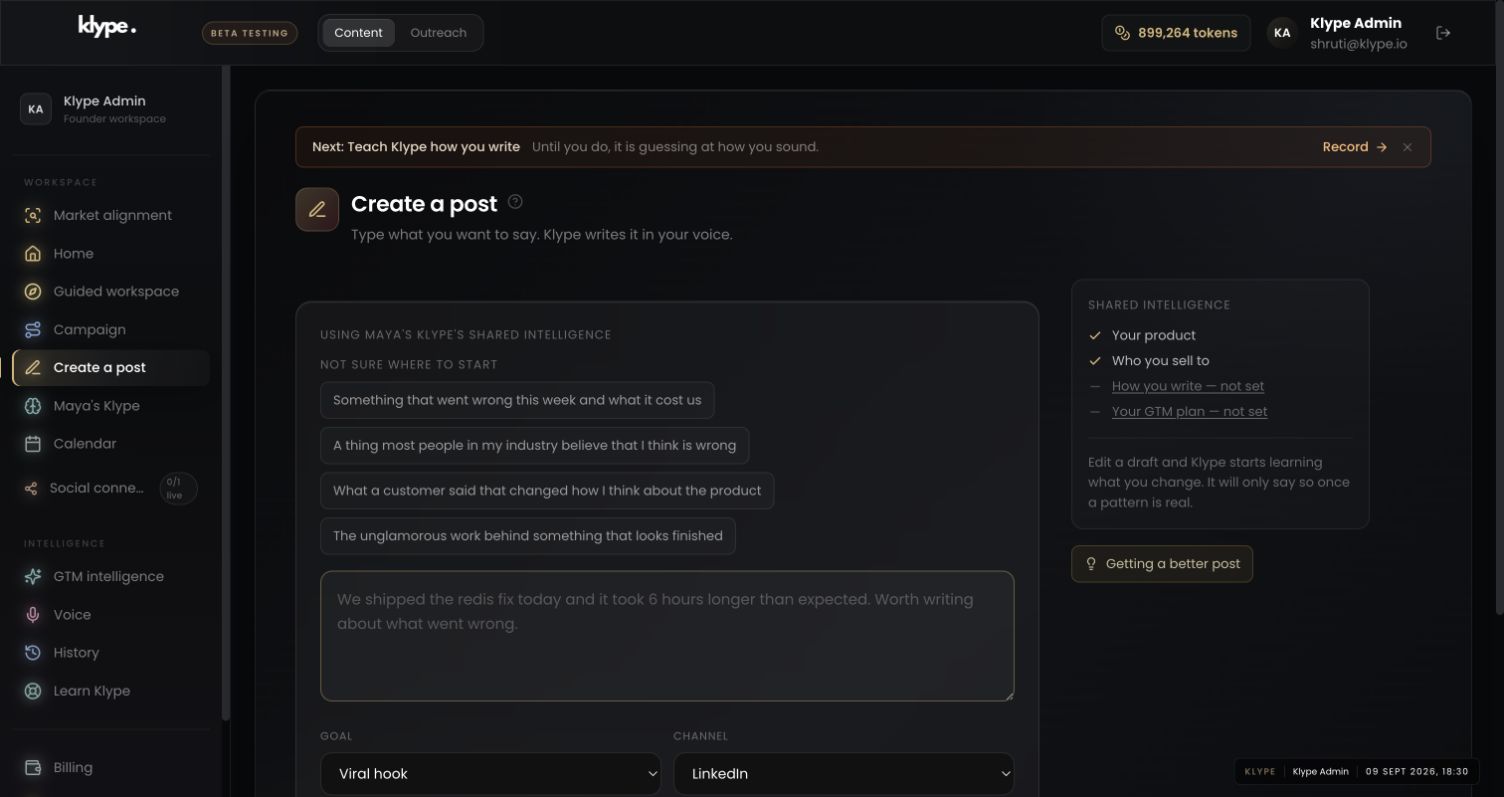
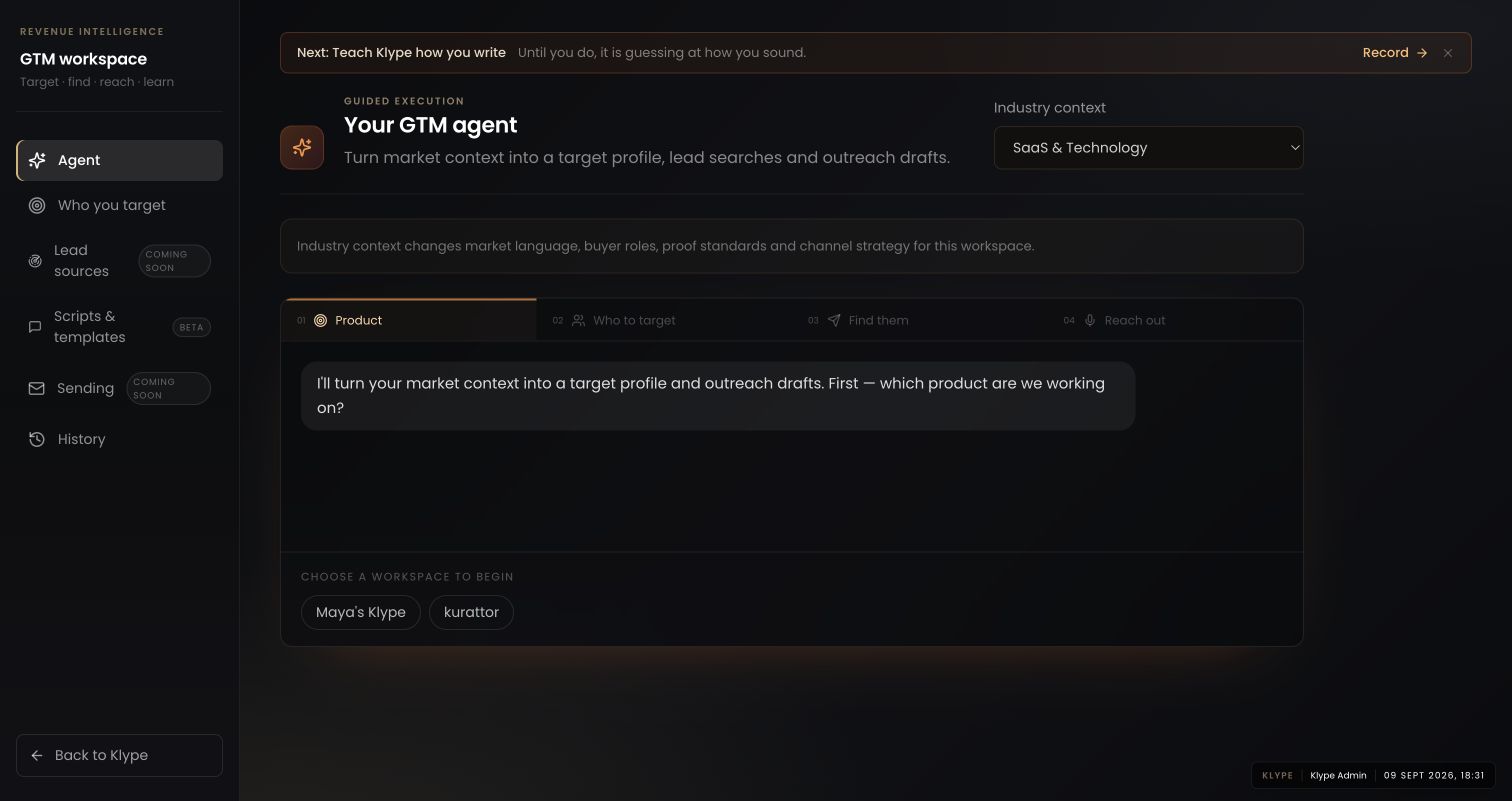
Real product captures from 9 September 2026, using the fictional Maya / Cedar Homes test workspace. These show the interface, not the article’s example being generated. The admin balance is not a plan allowance. Select a screenshot to inspect the full image, including the sidebar.
01Check the business context
Describe what the product can do now and keep planned capabilities separate. This screenshot shows the shared-context pattern, not your own SaaS data.
02Give the draft one clear job
Use one product decision as the brief. Review every sentence that turns an intention into a result.
03Connect the idea to a plan
Choose a buyer question for the next content cycle. Research and outreach suggestions should not be described as completed customer discovery.
Explain our decision to show one starting task after sign-up. State the aim and the trade-off for experienced users. Make clear that the outcome is not yet measured. Avoid claims about revenue, conversion or customer adoption.
Replace these example details with your own facts. This is a starting point, not a promise of a particular output.
Choose a problem your reader already recognises
Start with a specific situation rather than a category slogan. ‘A small team loses track of who owns the next follow-up’ is easier to evaluate than ‘the future of intelligent work’. Describe the current process and where it becomes difficult. If the problem comes from your own experience rather than customer research, say that.
Explain a product decision and its trade-off
Show why you chose one behaviour over another. You might explain why onboarding asks for fewer fields or why a feature is marked beta. State the downside as well as the benefit. Avoid claiming that a design choice improved conversion unless you have measured it. A thoughtful decision is worth explaining even before you know its result.
Give Klype a factual product boundary
In the workspace, separate available capabilities from planned ones. For a draft, try: ‘Explain why a small team should assign one owner to each follow-up. Describe our approach without claiming revenue results or automated integrations that are not live.’ Check the generated text against the actual product. Do not let a polished phrase quietly turn a roadmap item into a promise.
Invite a useful response
End with a question about the reader's process or a specific invitation to inspect a working example. If someone responds, use that conversation to refine the problem description. A sign-up, a saved card and an active customer are different events; describe them accurately in public. Avoid treating any single response as proof of product-market fit.
Try it with your own work
Keep a small approved-facts list beside your content work: available features, known limitations, actual user observations and measurements with dates. When a draft sounds impressive, check whether the list supports it. If not, turn the statement into an aim, a hypothesis or a question.
Build a simple sequence from one decision. First explain the problem in plain language. Next show the trade-off behind your approach. Later, return with what you actually observed. That final piece is useful even if the result is mixed. A documented correction can teach more than another launch announcement.
When the result needs work
Paste a LinkedIn draft and the free checker scores it in your browser. Your text stays in your browser.
Check current feature availability and checkout terms in the app.
Common questions
Can I publish before I have customers?
Yes. Share clear problem explanations and product decisions, while being honest about the stage and evidence.
Should every founder post promote the product?
No. A useful explanation can build understanding without a sales pitch. Connect the product only when it is relevant.